The Best Fluffy Pancakes recipe you will fall in love with. Full of tips and tricks to help you make the best pancakes.


If you’ve ever found a trail of tiny droppings in your pantry or heard the midnight scurry of uninvited guests, it’s time to declare war—Pantry Passion style. Setting mouse traps isn’t just about tossing bait and hoping for the best; it’s a tactical mission.
From choosing the right bait (hint: peanut butter reigns supreme) to placing traps like a seasoned farmhand, we’re diving into the gritty, no-nonsense tips that actually work. Whether you’re mouse-proofing your kitchen or going full-on trap commander, this guide is for those who are done playing nice and ready to reclaim their space.
DON’T MISS Pantry Passion’s Complete Article List for Mouse & Rat Prevention!
Table of Contents
- How to Set Mouse Traps the Right Way
- Mouse Bait Tricks
- Mouse Trap Placement
- More Tips to Give You the Mouse Trapping Advantage
- How Many Mouse Traps Do I Need?
- Faking Them Out: Neophobic Rats & Mice
- Getting Ready for the “Big Night”
- Types of Mouse Traps
- Best Mouse & Rat Trap Brands
- Mouse Trap FAQs
How to Set Mouse Traps the Right Way
Catching mice begins with understanding how to set a mouse trap.
That bent over loop on the bait plate? Yeah, that’s there for a reason. You’re supposed to stick the bait inside of it to make the mouse work harder to get the bait, thus snapping the trap.
Heck, some folks have taken devilish fun in this, jamming in toothpicks and even wrapping up the bait in string (a potential nesting material). Don’t be surprised if this is you after a few more mouse encounters!
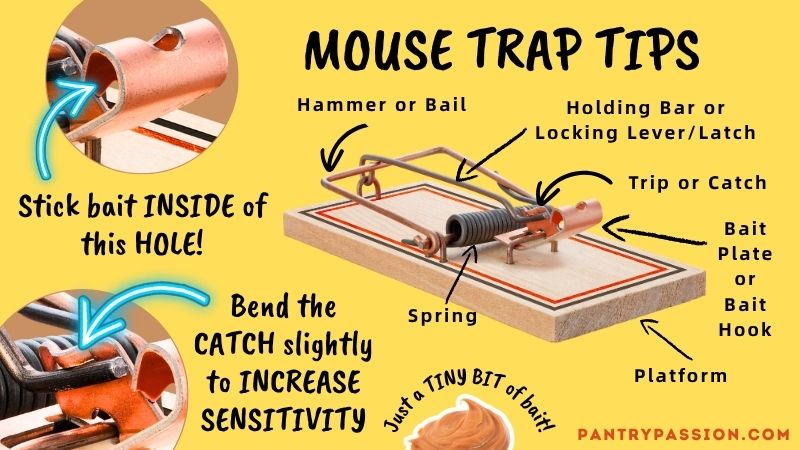
The wood traps themselves all have a big problem. The trigger is too stiff (this means that it takes a lot of force to trip the trigger). In that time, the mouse might already have the bait plate licked off!
Some people report that after two or three catches, the trigger begins to lose its sensitivity. If you find this to be the case, you might have to give up and toss the mouse trap away and get a new one.
This Tweak Increases Catch Rate to 100%
If your mouse trap bait keeps disappearing but you’re not catching any mice, it could time to adjust your trap.
Reddit member @MichaelRoberts-t7c explains it this way: “Use a pair of needle nose pliers and reduce the protrusion [catch] a bit so the bar is barely able to hold on. The spring trap is now super sensitive to any movement of the trigger plate.”
He also adds, “tune the trap bail so it is down tight against the base, or nearly so, on all three sides. I’ve caught mice by the tail and by the toe.”
There you have it – if your mouse trap isn’t triggering, you need to tweak it enough for success.
If you didn’t catch my comment earlier, the trap may lose its sensitivity after two or three catches. Save your time and replace with a new trap.
More Trap Tweaks
Screw mouse trap and rat traps down onto wood or plywood pieces. The energy inertia from a snapped trap on recoil (especially the large rat traps) can make it fly and NOT catch the rodent.
Mouse Bait Tricks
- Cover rat trap with attic insulation to camouflage, leaving the trigger exposed with peanut butter.
- Jam toothpicks or popsicle sticks into bait receptacles (crimp ends to stay put), and then cover with PB. Since mice like to gnaw, they will have to work for it, and more likely to trip the trap.
- Roll cotton (a perceived nesting material) in peanut butter then lace it inside of the trigger hole. This makes it where they have to work to get it out and of course making them put their head under the trigger means a higher success rate. Credit: Reddit monkeywelder.
- Bait mouse traps with what ever they are stealing (likely bedding material this time of year).
- Use drywall netting tape (also a potential nesting material) on the trigger of the snap, inhibiting the mice’s ability to escape (claws and teeth get caught in it).
Why Bait Vanishes Without a Catch
Well, if that isn’t adding insult to injury! The trap isn’t even tripped, but your bait is gone! Here are some reasons that frustrating problem might happen:
- Trap sensitivity is too low: The mouse can nibble without triggering the trap.
- Mice are too small: Baby mice could be attracted to your trap, but don’t worry – they grow fast!
- Too much bait: If you overload the bait cup, mice can steal bits without stepping on the trigger.
- Wrong trap placement: Mice prefer to travel along walls. If your trap is in open space, they might avoid it.
- Other critters: Ants, cockroaches, or even rats and squirrels might be stealing the bait.
- Trap size mismatch: If you’re dealing with a larger rodent, a standard mouse trap might not be strong enough.
Fixes For Missing Bait on Mouse Traps
- Use a pea-sized amount of bait: Just enough to lure, not enough to steal.
- Stickier bait: Peanut butter is ideal—it forces the mouse to linger and increases the chance of triggering the trap. Hardened chocolate jammed in the bait hole is another food that is hard to get out.
- Place traps flush against walls: Mice hug walls when they move. Position the trap perpendicular to the wall with the bait side closest.
- Try enclosed or humane traps: These prevent bait theft by requiring full entry before access.
- Upgrade your trap: If you suspect a rat or larger rodent, switch to a bigger, more powerful trap.
Mouse Trap Placement
Location, location, location! Think like a mouse (or a rat) and put traps where the mice are. Seems obvious, but if you are not familiar with rodent behavior, you could be wasting your time.
- Place trap snap ends (aka “danger end”) perpendicular to a wall: mice prefer following parameters of rooms. Mice like cover, but they also prefer the guidance that walls and paths offer.
- Place traps every 2–3 feet along walls where you’ve seen droppings, gnaw marks, or other signs of activity.
- Youtube member @Rottingboards screws on multiple Victor traps (with peanut butter on the trap mechanism) to a 2×4 board. He then slides the whole board under a building/outdoor shed. He reports it works great and can get multiple mice at once and it’s easy to take in and out in tight areas. He attaches eight traps to a 2×4.
- Mice can jump, and retain knowledge from mouse trap encounters. Instead of one trap running along a wall, put three mouse traps in succession, so if they jump over it, there is a greater chance the mouse will be caught. Some people also suggest to put two snap ends together.
- Mice like to have one side of their faces touching something as they walk/run around (such as baseboards or wall). Take advantage of that preference.
- Place mouse traps under things, behind couches and other furniture, closets, under kitchen stoves/refrigerators and kitchen cabinet toe kicks, or near boxes where mice are attracted to.
- Place traps along walls and corners, rodent’s favorite “runway”.
- “Mice do not typically travel more than thirty feet from their nest for food. If you’re seeing him in one room, there’s not really any point in putting a trap on the other side of your home because he will not go over there.” – Thermock
- @UrbanGardener in the ThanosHome.com forum uses flour dusting to track rodent routes before setting traps (a good way to see if mice are entering/exiting vents). This has increased their catch rate by 300%. You can also sprinkle baking soda, flour, or talcum powder to track mouse movement (as mentioned in my mouse proofing kitchen and pantry article.
More Tips to Give You the Mouse Trapping Advantage
If you thought there was nothing to setting a mouse trap, you’re wrong. Here are a few more tips to assure your trapping goes well:
Make Mouse Trap Cozy & Inviting
- Create tunnel by placing 2 long cans together with tops and bottoms removed. Place sticky glue trap inside.
- Block off sides and back of trap so mouse has to go through the front.
- Place trap in paper bag or cardboard box to create feeling of safety.
- Lay bucket on the side and put mouse trap inside of it, that way only one way in.
Dead Mouse Advantage
- Finding dead mice in part of the house may be a clue where rodents are getting in from – mouse-proof heavily targeting this location.
- The scent of a dead mouse, even after removing it from a trap, will attract other mice. Best practice is to not disinfect the trap, unless human hands have touched it.
- Don’t Touch! How Your Human Scent is a Fail. Never touch a trap with your bare hands, mice will avoid the human scent you leave behind – their noses are HIGHLY SENSITIVE to even the weakest scent. You don’t want the oil from your skin to absorb into the trap and turn the rodent away.
- Wash hands well BEFORE putting bait on trap, then put on rubber gloves. I stupidly pulled apart a sticky glue trap to take a picture – duh! I ended up putting a visible sign where I store my mouse poison and traps not to make that mistake again!
- See below in the FAQ how to get human scent off of mouse traps.
Don’t Touch! How Your Human Scent is a Fail
Never touch a trap with your bare hands, mice will avoid the human scent you leave behind – their noses are HIGHLY SENSITIVE to even the most weakest scent. You don’t want the oil from your skin to absorb into the trap and turn the rodent away.
Wash hands well BEFORE putting bait on trap, then put on rubber gloves. I stupidly pulled apart a sticky glue trap to take a picture – duh! I ended up putting a visible sign where I store my mouse poison and traps not to make that mistake again!
See below in the FAQ how to get human scent off of mouse traps.
How Many Mouse Traps Do I Need?
If you’re as lucky as Reddit user maybethingsnotsobad, you will be super-efficient at catching multiple mice at a time: “I had mice move into the garage. First night I put out 4 traps. Caught 5 mice. Put out 7 traps, caught 9 mice.”
To outsmart mice, quantity matters more than you’d think. Here’s a solid strategy based on expert advice:

Quantity Guidelines:
- Use traps in pairs in high-traffic areas to increase catch rates.
- Minimum of 6 traps per suspected mouse is a good rule of thumb—because the “one mouse, one trap” theory rarely works.
- Multi-catch traps like the Victor Tin Cat can catch up to 30 mice in one go, which is ideal if you suspect a larger infestation.
Pro Tip:
Even if you’ve only seen one mouse, assume there are more. Mice are social and reproduce quickly. So go heavy on traps early to avoid a full-blown infestation.
Faking Them Out: Neophobic Rats & Mice
It’s also important to “fake out” the mice. Victor Pest says that regardless of the type of trap you are using, let it set out a few days un-baited and un-set. The mice will run around it, sniff it, and then accept it in their ecosystem.

After a few days, add the bait chunk, poison pellets, or dab of food of choice. Tip: make sure there is mouse activity (dropping, chewed paper, etc.) before you do set the trap.
An anonymous Reddit user explains it this way: “They [mice] are extremely neophobic, meaning they tend to be fearful of any new objects in their environment.” Understanding neophobia in rats and mice gives you the patience you need to be patient for your mouse hunt.
Behavioral Breakdown:
- Rats tend to be highly neophobic. They often avoid unfamiliar objects, foods, or changes in their environment.
- Mice, on the other hand, are typically more neophilic—meaning they’re curious and more likely to explore new items or spaces.
Since rats are the more neophobic of the two, trapping them in the summer when other food sources are readily available, becomes more difficult. In the winter, when food is scarce, the rats ultimately overcome their fear of traps and poison in favor of survival.
Neophobia could be the main reason you’re not catching mice with snap or sticky glue traps. Understanding rodent behavior is the secret to catching more mice.
Getting Ready for the “Big Night”
I chuckled with the advice from Victor Pest to “plan on a big first night.” They recommend to first space traps really close together, as much as 1″ apart for a really bad mouse problem – and use different kinds of bait. These people have my complete and utter respect.
There are lots of videos for people “getting ready for a big first night” – enjoy this one from Everything Homestead.
Types of Mouse Traps
This article is mainly geared to traditional wooden mouse traps (snap traps). Honestly, I just refer to them as “mouse traps.” Wikipedia has a good overview of all the different types of traps including the history.
The “Little Nipper,” mouse trap is one of the first spring-loaded bar traps patented particularly for rat-sized versions (credit to British inventor James Henry Atkinson). Victor mouse traps have been around over a century, as the brand’s revolutionary spring-based wooden snap trap was invented in 1898 by John Mast. The design was so successful that it became the standard for rodent control and remains one of the most popular and iconic mouse traps to this day.
Today, there are more options for mouse trap designs, but the basic design has been tried and true.
- Snap Traps
Classic design with a spring-loaded bar that quickly kills the mouse. Effective and inexpensive. Comes in both traditional wooden styles and plastic. Another version of this is “no-see” “no-view” or “no-touch” mouse traps that are fully enclosed for people who have a fear of mice. - Glue Traps
Sticky boards that trap mice when they walk across. Best for low-traffic areas and quick setups. They have their place, but most people argue they are inhumane. - Live Catch Traps
Humane traps that capture mice without harming them, allowing for release elsewhere. - Electronic Traps
Deliver a high-voltage shock for a quick kill. Clean, efficient, and reusable. The Rat Zapper had the best success rate but needs frequent battery changes in cold weather. - Bucket Traps
DIY or commercial setups where mice fall into a bucket and can’t escape. Great for multiple catches. Rolling log traps is a variation of this. - Multiple-Catch Traps
Designed to catch several mice at once, often used in commercial or high-infestation settings. - Bait Stations
Enclosed units that hold poison bait safely away from pets and children. Not technically traps, but often used in tandem. - Tunnel or Box Traps
Enclosed snap or glue traps that keep the mechanism hidden—ideal for homes with pets or kids.
Best Mouse & Rat Trap Brands
Here are recommended types of mouse and rat traps along with top brand suggestions for each category:
| 🧰 Trap Category | 🏷️ Recommended Brands / Models | 💡 Notes |
|---|---|---|
| Best Snap Mouse Traps | Tomcat Press ‘N Set, Victor Easy Set, Snap-E Mouse Trap | Quick kill, reusable, budget-friendly |
| Best Glue Mouse Trap | Catchmaster Max-Catch, Tomcat Glue Traps, Garsum Glue Boards | Non-toxic, easy to use, ideal for low-traffic areas |
| Best Live Mouse Traps | Motel Mouse Live Catch, Catcha Smart Trap, Havahart 1020 | Humane catch-and-release, safe for homes with pets |
| Best Bucket Traps (Dizzy Dunker/Rinne designed by mouse trap expert Shawn Woods) | RinneTraps Flip N Slide, Rolling Log Trap (you provide the bucket) | High-capacity, auto-reset, great for barns and garages |
| Best Humane Mouse Traps | CaptSure Original, Kat Sense Humane Trap | No-kill, endorsed by humane societies, reusable |
| Best Mouse Traps for Infestation (Dizzy Dunker/Rinne designed by mouse trap expert Shawn Woods) | RinneTraps Flip N Slide, Victor Tin Cat M310GB, Catchmaster Multi-Catch | Multi-catch, ideal for large infestations |
| Best Mouse Trap for Kitchen | Tomcat Press ‘N Set, Catchmaster Glue Traps, TwinTech Jaws | Discreet, easy to clean, safe around food prep areas |
| Best Mouse Traps for Attic | Feeke High Sensitivity Trap, Kat Sense Tunnel Trap, Catchmaster Glue Boards | Pet-safe, durable in humid conditions, easy placement |
| Best Mouse Traps for Garage | Victor M241 Electronic Trap, Tomcat Press ‘N Set, Catchmaster Snapper | Effective in cold/dusty environments, reusable |
| Best Mouse Traps for Outside | Kat Sense Bait Station, Victor Easy Set, RinneTraps Flip N Slide | Weather-resistant, safe for outdoor use |
| Best Outdoor Rat Traps | eXuby Rat Trap, Havahart Catch-and-Release, Montrap RK1000K2 Electric Trap | Powerful, humane options available, reusable |
| Best Mouse Traps for Homes With Pets | Catchmaster Multi-Catch, Motel Mouse Live Trap, OWLTRA Electric Trap | Pet-safe designs, enclosed mechanisms, no poison |
| Best Field Mouse Traps | Victor Electronic Trap, Tomcat Snap Trap, Kat Sense Covered Trap | Durable, effective in outdoor and rural settings |
Why Isn’t D-Con on the List?
D-Con is also a well-known brand in the U.S. mouse trap market, especially for its covered snap traps and bait stations. D-Con is more associated with rodenticide products (like poison bait stations) than with mechanical traps like snap or electronic models. But that doesn’t mean it should be overlooked.
D-Con is often the brand to trust for best pet-safe mouse traps, best covered mouse traps, and best discreet mouse traps.
What are “Big Cheese” Mouse Traps?
A “Big Cheese mouse trap” is a specific brand of rodent control products from the UK that includes various styles of traps, such as powerful snap traps, humane live catch traps, and electronic killers. These traps are known for being ready-to-use, often pre-baited with a special attractant, and are designed for effective and safe mouse control in homes and other buildings.
Mouse Trap FAQs
How to Catch a Mouse That Avoids Traps
Catching a mouse that avoids traps requires a smarter, more strategic approach. Start by placing traps along walls and hidden pathways where mice naturally travel, and always wear gloves to avoid leaving human scent on the devices. Switch up your bait—peanut butter, hazelnut spread, or even chocolate can be more enticing than traditional options. If snap traps fail, try live traps, which can be more effective against trap-shy mice. If you have an elusive mouse, you may have to resort to poison. Patience and persistence are key, and if all else fails, professional pest control may be your best bet.
Mouse Trap Bait Gone, No Mouse
If your mouse trap bait keeps disappearing but no mouse is caught, you’re likely dealing with a clever or cautious rodent—or possibly a different pest altogether. Mice can sometimes nibble bait without triggering the trap, especially if it’s not positioned properly or overloaded with bait. Other culprits like ants, cockroaches, or even larger animals such as rats or squirrels might be stealing the bait without setting off the trap. To improve your chances, use a small amount of sticky bait like peanut butter, place traps flush against walls, and consider switching to more sensitive or enclosed trap designs.
How Many Mouse Traps Do I Need?
The number of mouse traps you need depends on the severity of the infestation, but more is usually better. Experts recommend placing traps every 2 to 3 feet along walls where you’ve seen signs of activity, and using at least six traps for every suspected mouse. Setting traps in pairs or clusters increases your chances of success, especially in high-traffic areas. Since mice are social and reproduce quickly, acting aggressively with multiple traps can help you get ahead of the problem before it escalates.
Source – VictorPest.com
How to Remove Human Scent From Mouse Traps
To remove human scent from mouse traps, always wear gloves when handling them to avoid transferring oils and odors from your skin. Mice have an incredibly keen sense of smell and can detect even faint traces of human presence, which may cause them to avoid the trap. You can also wipe traps down with unscented alcohol or let them sit outdoors for a few hours to air out. Avoid checking or repositioning traps frequently, and place them in low-traffic areas to minimize scent contamination.
Source: PestClue.com
How to Clean Mouse Traps
To clean mouse traps safely and effectively, start by wearing gloves to protect yourself from bacteria or pathogens. Dispose of any dead rodents and leftover bait, then wash the trap thoroughly with hot water and soap. For deeper sanitation, disinfect with a solution of one part vinegar to ten parts water or use rubbing alcohol. Let the trap air dry completely before reusing it, and always check for damage or wear that might affect its performance. The only reason not to clean the trap is because you don’t want other mice to be attracted to the dead animal smell (which they are and can work in your favor).
How Do Mouse Traps Kill?
Mouse traps kill by delivering a swift and targeted force designed to eliminate the rodent instantly. Traditional snap traps use a spring-loaded bar that snaps down on the mouse when it triggers the bait mechanism, ideally causing immediate death through trauma to the neck or skull. Glue traps immobilize the mouse, leading to death by hypothermia or dehydration over time. Electronic traps deliver a lethal electric shock when the mouse enters the chamber, while poison bait stations cause internal organ failure after ingestion. Each method varies in speed and humaneness, but all aim to control infestations efficiently.
Source: FamilyHandyMan.com
Peanut Butter Mouse Trap Not Working
If your peanut butter mouse trap isn’t working, it might be time to rethink your setup. Mice are surprisingly cautious and can detect human scent, so always handle traps with gloves. Using too much bait allows them to nibble without triggering the trap—stick to a pea-sized amount. Also, stale peanut butter loses its appeal, so refresh it regularly or try another type of nut butter. Placement matters too: traps should hug walls and sit in areas of known mouse activity, not open spaces. If the mice have already had a close call with a trap, they may be avoiding it altogether.
Can a Mouse Trap Kill a Rat?
A standard mouse trap is generally not strong enough to kill a rat due to the significant size and strength difference between the two rodents. Rats can weigh up to 18 times more than mice and often escape or drag away lightweight mouse traps without being fatally injured. While a mouse trap might injure a rat, it’s unlikely to deliver a lethal blow. For effective rat control, larger and more powerful traps specifically designed for rats—such as heavy-duty snap traps or electronic traps—are recommended.
Source: ColonialPest.com
Can a Mouse Move a Trap?
Yes, a mouse can sometimes move a trap, especially if it’s lightweight or poorly secured. Larger or stronger mice may drag glue traps or unset snap traps across the floor in their struggle to escape. If only part of their body—like the tail—is caught, they might still have enough mobility to shift the trap’s position. However, smaller mice or those fully immobilized are less likely to budge it. To prevent this, place traps flush against walls, use multiple traps together, and ensure they’re stable and properly baited. In addition, the force of the snap can flip it into the air. Especially for rat traps, consider screwing down to a floor or larger piece of wood to overcome that flip that can let the mouse escape.
Can a Mouse Trap Kill a Chipmunk?
A standard mouse trap is typically too small and weak to reliably kill a chipmunk, which is larger and more robust than a mouse. While it’s possible for a chipmunk to be injured or even killed by a mouse trap, success is inconsistent and often inhumane. For more effective and ethical control, larger snap traps designed for rats or electronic traps are better suited to handle chipmunks swiftly. If you’re aiming for a humane approach, live-catch cage traps are a safer alternative for relocation.
Can a Mouse Trap Kill a Squirrel?
A standard mouse trap is generally not powerful enough to kill a squirrel, which is significantly larger and more resilient than a mouse. While there are rare cases where a spring-loaded trap might injure or even kill a small squirrel, it’s not a reliable or humane method of control. Squirrels often escape with injuries, leading to prolonged suffering. For effective and ethical management, larger traps specifically designed for squirrels or live-catch cage traps are recommended, and local wildlife regulations should always be considered before taking action.
Can I Reuse Mouse Traps?
Yes, you can reuse mouse traps, especially types like plastic snap traps, electric shock traps, and live catch-and-release traps. Reusing traps is cost-effective and environmentally friendly, but it’s crucial to clean them thoroughly after each use to remove any residue, scent, or fluids that might deter other mice (or leave it – mice are attracted to smells of other mice, even dead ones!). Always wear gloves when handling used traps to prevent the spread of bacteria and to not transfer human scent to the trap.
Some people report that after two or three catches, the trigger begins to become not so sensitive. If you find this to be the case, you might have to give up and toss the mouse trap away and get a new one.