The Best Fluffy Pancakes recipe you will fall in love with. Full of tips and tricks to help you make the best pancakes.


Yes, cats can help keep mice away — but they’re best used as part of a broader pest control strategy. If you’re counting on the smell of the cat to deter mice, it’s possible, but not a sure bet.
Are you wanting cats to “do the dirty deed” and kill the mice? Cats work, though it really depends on the cat. Some cat owners will say that forget it, cats aren’t good for rodent control. Others report much better luck with dogs, especially terriers.
Then there are the epic mouse hunt stories – some cats are simply incredible! Read on to learn everything you need to know about encouraging cats to catch mice, and their mouse-munching behaviors.
DON’T MISS Pantry Passion’s Complete Article List for Mouse & Rat Prevention!
If worried about using peppermint oil around cats, check out Pantry Passion’s Guide to Peppermint Oil – I have some useful info in there about cats and peppermint oil safety.
Table of Contents
- Does a Cat Keep Mice Away?
- Farm Wisdom: Which Cats Are Better Hunters?
- Will a Cat Kill a Mouse – How About Rats?
- How Long Does it Take a Cat to Kill a Mouse?
- Eating the Prize: Mouse Main Course
- How to Stop Cats Catching Birds and Mice
Does a Cat Keep Mice Away?
Yes — but it’s not a guaranteed fix.
In my dog article, I mentioned DoggySaurus took a deep dive into this question for both dogs and mice. Their conclusion: these pets are not effective entirely in keeping mice away. They cited a University of Florida study that indicated that mouse populations do not decline in the presence of dog and cats on rural homesteads.
Do cats get rid of mice? There is plenty of anecdotal evidence that would say otherwise. Homeowners claim that mice left their house after bringing a cat in. Even if you have the best mouser in the world, they can’t get mice that are happily nesting in your walls.
Are Mice Afraid of Cats?
- Predator scent: Mice are instinctively afraid of cats. The smell of cat urine, poop, or fur can make mice avoid certain areas. It can even release stress hormones within the mouse.
- Territory patrol: Cats often roam and mark their space, which discourages mice from settling in.
- Hunting behavior: Some cats actively chase, catch, and kill mice — especially breeds like Maine Coons, Bengals, and Siamese.

Can Cats Smell Mice?
Cats have an exceptional sense of smell and can absolutely detect mice—even from impressive distances. Their olfactory system is 14 times more sensitive than a human’s, enabling them to pick up even faint traces of mouse scent. -Source: Vet Explains Pets
While exact distances vary, experts suggest cats may be able to smell mice from hundreds of feet away, and possibly up to a mile under ideal conditions like low wind and minimal competing odors.
Even if a cat has never seen a mouse before, the scent alone can trigger predatory instincts—they’ll become alert, may crouch to the ground, or paw at one spot – ready to hunt.
Limitations of Cats (AKA “Mousers”)
- Not all cats hunt: Some cats are more playful than predatory. Others may ignore mice entirely.
- Mice adapt: Rodents may simply relocate to parts of the house your cat doesn’t frequent — like inside walls or attics.
- Food attraction: If your home has accessible food, mice may risk sneaking in despite the feline threat.
Farm Wisdom: Which Cats Are Better Hunters?
When you have a lifetime and a herd of cats to observe, farm folk get a feeling of what cats perform the best as mousers. Yesterday Tractors forum posed the question, “What gender of cat is the best mouser?” The responses were surprising.
Here is a summary of opinions:
- A hungry cat just seems to lay around begging for food and doesn’t want to hunt.
- Overwhelmingly, forum users agreed that females are more aggressive hunters because they’re on a mission to feed their babies (they’re more motivated to hunt).
- It doesn’t matter if cats are neutered/spayed, they are still good hunters. Intact tomcats start to roam and fight other cats and can leave the farm for long periods (and not benefit the farm in terms of mouse duties).
- Multiple users commented that calico cats seemed to have superior genetics for mouse hunting AND good dispositions with humans.
- The breed Maine Coon cats was mentioned. Originating from Maine and New England, they are one of the largest cat breeds, with a rugged build developed for cold climates.
- Bob tail cats are really good hunters.
- Other believe that tomcats are lazy, citing that “Getting fixed and fat takes the hunt out of them.”
I just realized that I have a Maine Coon cat on my farm! This was a stray that turned up and has been around for many years. The darn thing is HUGE, but I didn’t know about cat breeds until now.
I think it might have come from a batch of cats we adopted from my brother in town. His daughter was feeding all of the stray cats and got in trouble with the city, lol! (we do intentionally seek out other genetics to avoid inbreeding of farm cats).
Maine Coons are known for their strong hunting instincts, but also their shaggy coats and fluffy tails. Then I came across info that said short-haired breeds often make more consistent hunters. So which is superior? Both. Pick your cats based on their individual prey drive.
It’s also worth mentioning that our gray/black tiger-striped cat numbers are the larger population on the farm. I think they outlasted due to their superior camouflage. It helps with hunting, but also prevents them from becoming prey to hawks, eagles, coyotes, etc.

House Cats vs Barn Cats
As a farmwife, my experience with barn/farm cats is very different than someone with house cats. It doesn’t matter what category your cat fits in below, a cat’s individual ability to catch mice ranges from average to legendary (that from which amazing mousing stories will be told years later!).
Let’s consider the differences:
| Feral Cat | Stray | Barn Cat/Farm Cat | House Cat |
|---|---|---|---|
| DESCRIPTION | |||
| Feral cats are wild and afraid of humans. | Stray cats are abandoned or lost pets. | Barn or farm cats are often tame, but can be semi-wild. | House cats are family pets and are very tame. |
| HUNTING TRAITS | |||
| Feral cats hunt out of instinct and survival. They may live in woods or seek shelter near humans. | Stray cats also hunt out of instinct and survival, but will not hesitate to approach people and businesses for food. | Barn/farm cats have plenty of opportunities to hunt mice, it’s their job. Their owner may also supplement with food scraps, commercial pet food, or milk from dairy cows. | May still hunt out of instinct, even if they’re well-fed with commercial pet food. |
| EATING MICE | |||
| Tend to eat mice whole in a hurry to avoid predators. | May also eat mice whole because their hungry. | May not eat the kill if they’re teaching their offspring to hunt. | Well-fed cats tend to play with mice first. They might not eat them because they’ve never learned to hunt them or don’t see the point in eating them. |
| ABILITY | |||
| Feral cats’ very survival depends on their hunting skills. | Stray cats’ survival depends on hunting skills and taking opportunities of available food (dumpsters/charity). | Barn/farm cats ability at catching mice ranges from average to epic. | There are certain domesticated cat breeds that excel at catching mice. |
Note: Older cats may lose their interest in hunting, depending on their overall health. Age may reduce their quickness and agility, making it more difficult to bother with catching mice.
Will a Cat Kill a Mouse – How About Rats?
Yes, a cat will kill a mouse if you have one. Cat are born predators. I just watched a farm cat the other day patiently observe a mouse hiding in a bush outside of my house, pouncing on it at the right moment.
House cats are not as needy in terms of survival and food, so they may only stun the mouse. Playing with the mouse is a form of entertainment for them. It’s life and death to wild feral cats; they will kill and eat the mouse because they don’t know when their next meal will be.
As for rats, they can kill them too, but it is more unlikely. Adult rats are bigger and heavier than mice, making them more challenging to confront and catch. Cats can much easier kill juvenile, rats, or a nest of baby rats if they come across them.
How Do Cats Kill Mice?
Cats are born hunters. They kill a mouse with these methods:
- Stalk and pounce with precision thanks to their agility and stealth.
- Use their teeth to deliver a fatal bite, often to the neck or head.
- Rely on speed and coordination to chase and trap prey.
In the winter, my farm cats are fed cat food. I discontinue it in the spring to make the cats hungry enough to hunt mice. They are supplied with some milk at this time (usually calf milk replacer) for the pregnant mommas before birth. I stop giving milk when the kittens emerge (milk replacer gives them scours). However, I can give a tiny bit of cat food to tame them.
-Farmwife Renee, PantryPassion.com
Do Cats Hunt Mice?
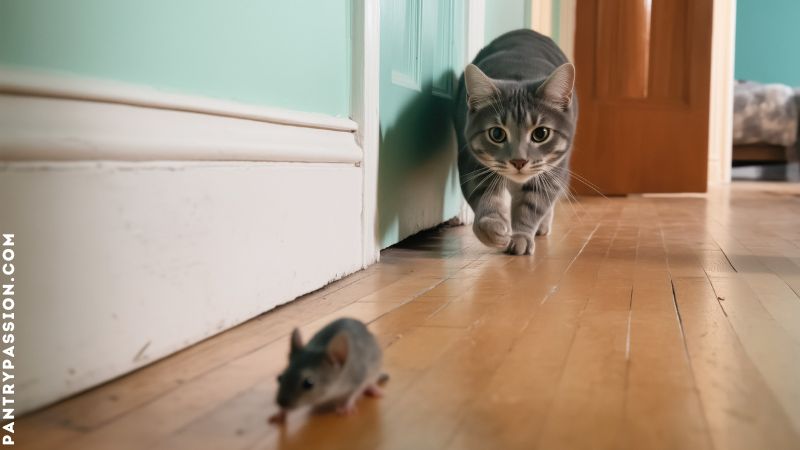
Cats are natural predators, and mice are one of their most instinctive targets. Cats use a mix of stealth, patience, and lightning-fast reflexes:
- Stalk and Pounce: They crouch low, silently approach, then spring with precision when the moment’s right.
- Ambush: Some cats prefer to wait motionless near mouse holes or nests, striking as soon as the mouse appears.
- Hooking Technique: Cats may use their paws like hooks to snag mice from tight spaces.
- Kill Method: Once caught, cats typically bite the mouse’s neck or head for a quick kill, or shake it to cause fatal internal injuries.
Domestic cats often hunt not out of hunger, but because it satisfies their instincts and curiosity. It’s part play, part primal drive.
How to Train a Cat to Catch a Mouse
Catching mice is an instinct. Kitten mates playing and pouncing together is training for future stalking. Interacting with cats using feathers and strings is fun for both the human and the cat, but it’s really prep for mouse catching.
On the farm, when a mouse opportunity arrives, there are often barn cats in the vicinity. Even better if we find a mouse in a barrel. I simply scoop the cat in and toss it by the mouse, and instinct takes over. There’s nothing better than seeing a proud cat with it prey in the mouth.
A little praise never hurt anyone, including cats. Encourage them when they show interest in mice or congratulate them when they successfully catch one.
- Let mother cats teach mouse skills. Best scenario: momma cats will train their young how to hunt.
- Consider a mentor cat: Pair your cat with an experienced mouser, AKA mentor cat. If you’re open to it, a second cat with strong hunting instincts might teach yours by example.
- Expose cats to mice. Draw your cat’s attention to a rodent area (cats can smell the mice and scent-mark the area which can deter rodents).
Declawed Cats Can Still Hunt
I have enjoyed a few trips to Germany visiting friends and relatives. These acquaintances have often shared stories of their cats bringing in dead mouse, gophers, birds, etc. and presenting their trophies to their owners. It happens, but it seemed to happen more frequently to these people across the pond.
Well, I googled it and discovered that people in Germany do not declaw cats because the practice is illegal and considered a form of animal cruelty. For the record, none of my barn cats are declawed. If you would like to see a complete lists of places where declawing is illegal, click here.
Declawed cats have been known to catch mice:
- They use their paws to pin the mouse down.
- Their jaw strength and bite become the primary tools.
- Some even shake the mouse to cause internal injuries.
Claws aren’t a must-have, but they’re definitely helpful with gripping and holding down the prey. Cats with claws can also climb trees and building interiors/exteriors to complete their pursuit.

Why Do Cats Bring Back Dead Mice To Me?
Some old-timers claim that the best cat hunters are also the ones who’ll bring animals into the house as well. Honestly, it’s perfectly normal cat behavior.
Cats bring dead mice to their humans for reasons that are surprisingly sweet—if a bit gruesome. Here’s what’s going on behind those tiny murder gifts:
- You’re family: In the wild, mother cats bring prey to their kittens to teach them how to hunt. When your cat drops a mouse at your feet, they may see you as a slightly clueless kitten in need of training.
- Sharing the bounty: Cats often bring their catch home to a safe space. If they trust you, they might be offering you a share of their “meal” or showing off their skills.
- It’s not only mice, cats bring other gifts. Toy mice, socks, or random objects they “hunt” indoors can also be placed at your feet. It’s the same instinct, just redirected.
It’s a little wild, a little weird, and totally feline according to Live Science. If your cat’s ever gifted you a mouse, consider it a compliment—just maybe not one you want to frame.
How Many Mice Do Cats Eat In A Day?
AskMyCats.com states that “the average feral cat will consume nine mice per day.” I have no idea where the statistic was taken from. I’m certainly not keeping track of my farm cats’ kills. Occasionally I witness them skirting off with a mouse in their mouth, but I’m not keeping tally.

How Long Does it Take a Cat to Kill a Mouse?
It can take anywhere from a few seconds to several minutes for a cat to kill a mouse — depending on the cat’s hunting style, experience, and motivation.
Experienced hunters (like feral or outdoor cats) often go straight for the neck or head, killing the mouse almost instantly.
Indoor or well-fed cats may “play” with the mouse first — batting it around, tossing it, or chasing it — which can prolong the process for several minutes.
FACTORS THAT AFFECT KILL TIME
- Age & agility: Younger, more agile cats tend to be faster.
- Hunting instinct: Some breeds (like Maine Coons or Bengals) have stronger prey drives.
- Environment: In cluttered or confined spaces, the chase may take longer.
- Motivation: Hungry cats tend to kill faster; bored or curious cats may toy with their prey.
What if My Cat Won’t Kill a Mouse?
This can be frustrating if you’ve enlisted your cat to solve your mouse issue. Let’s not take it out on the cat. There are some very good reasons why your cat won’t kill mice:
- Lack of early exposure: Cats often learn hunting from their mothers. If your cat didn’t grow up around mice or a hunting mentor, it may not know what to do.
- Play vs. prey: Many domestic cats catch mice just to play with them. They may bat them around, release them, and repeat — not out of cruelty, but instinctual behavior.
- Personality matters: Some cats are more curious or gentle by nature. Others may simply not have a strong prey drive.
- Well-fed and comfy: If your cat’s belly is full and life is cozy, it might not feel the need to hunt for survival.
Most pest exterminators will tell you, pest control is a multi-method approach. Don’t rely solely on your cats. Follow best practices to mouse-proof your home.

Eating the Prize: Mouse Main Course
There are some funky questions when it comes to cats eating mice. If you’re scratching your head about bizarre behavior, let me explain…
Why Do Cats Eat Mouse Heads?
According to AskMyCats.com, the head is the most favorite part of the mouse body for a cat to eat, a delicacy, in fact.
- Nutrient-rich: The brain and eyes contain fats and proteins that are especially appealing to cats.
- Instinctual targeting: Going for the head ensures a quick kill — it’s a survival tactic hardwired into feline behavior.
- Taste preference: Some cats genuinely prefer the texture and flavor of the head over other parts.
- Symbolic “trophy”: In some cases, cats eat the head and leave the rest as a kind of offering or display — especially for their humans.
This is not to say that cats eat the head first, or only the head. Some may jump in and eat the whole mouse (especially when under the pressure of other cat buddies watching). The cat may just end up playing with their prey and never eating it at all.
Do Cats Eat Mice Whole?
Yes, cats eat mice whole, but not if they don’t have to. If it’s a baby mouse – that’s one gulp – easy. So it really depends on the size of the mouse. I mean, really, would you eat a whole chicken?
Can cats choke from eating a whole mouse? Actually, yes. Cats can choke if eating too quickly. Call your vet if your cat is exhibiting strange behavior or trouble breathing.
Do cats eat the bones of mice? Yes, eating the mouse whole means meat, organs, bones and all.
They may leave behind the stomach, spleen, or tail, especially if those parts taste bitter or are harder to digest. AskMyCats.com adds “Others will eat mouse guts for a time but refuse to eat the gizzard because of its acidic flavor.”
Cat eating behavior is really like human eating behavior, in a sense. They have the parts of the mouse they like to eat, and part they don’t like to eat.
Is it Safe for Cats to Eat Mice?
Cats’ teeth, stomach acid, and digestive systems are well-equipped to handle bones, fur, and raw meat – don’t worry about that part. However, there are other considerations that make eating mice not entirely risk-free.
Potential Risks:
- Parasites: Mice can carry fleas, roundworms, tapeworms, and Toxoplasma gondii, which can infect your cat and even pose risks to humans.
- Rodenticide Poisoning: If the mouse has ingested poison, your cat could suffer secondary poisoning. While rare from a single mouse, repeated exposure increases the risk.
- Bacterial Infections: Mice may harbor harmful bacteria like Salmonella or Leptospira, which can cause illness in cats.
- Internal Injury: Sharp bones could, in rare cases, puncture the digestive tract.
Be sure to monitor your cat(s) for symptoms like vomiting, diarrhea, or lethargy after a mouse snack. Lethargy is a sign that they have eaten a mouse which has been poisoned. House cats should be kept on a monthly parasite prevention. If you suspect the mouse was poisoned or your cat seems unwell, call your vet immediately.
How to Stop Cats Catching Birds and Mice
It’s pretty hard to have any animal go against their natural instinct. Cats are natural-born hunters, but there are ways to reduce their obsession with catching and killing mice. Here’s a mix of proven strategies to help protect birds, mice, and your peace of mind:
Bells, Bright Collars, and “Catios”
- Keep house cats inside, or limit outdoor time.
- Interact with house cats during playtime to satisfy their hunting drive.
- Review their diet, they may be hankering for more protein.
- Belled cat collars can reduce bird kills by up to 50% and rodent kills by 61%.
- Birdbesafe collars, with bright rainbow colors, make cats more visible to birds and reduce bird predation by up to 87%.
- Build a screened in catio (cat patio) that lets your cat enjoy the outdoors safely without harming birds and catching mice.
- Leash training your cat is another way to give supervised outdoor time without hunting.
Last advice: Don’t reward or scold your cat for bringing a dead rodent to you. Quietly dispose of it and redirect their attention to toys. These steps won’t erase instinct, but they can dramatically reduce your cat’s impact on local wildlife.