
The Best Fluffy Pancakes recipe you will fall in love with. Full of tips and tricks to help you make the best pancakes.


HOLY MOLY, people! ONE pantry moth can lay over 400 eggs! Imagine that multiplied by several larvae munching away on your pantry food. Check my pantry moth page out to see the lifecycle of a pantry moth… folks, a cycle is a continuous circle, and it can go on and on unless you STOP IT. An infestation can turn serious quickly.
Learn about how to prevent pantry moths from getting into your house in the first place, how to take away their food source, and how to eradicate them from your home.
Table of Contents
- What causes a pantry or Indian moth infestation?
- Things pantry moth larvae eat
- Pantry moths and paper
- Mystery sources of food for pantry moth larvae
- Indian meal moth prevention
- How to get rid of an Indian moth infestation
- Indian meal moth killer, what you need to know
- How to kill pantry moths naturally
- In conclusion
What causes a pantry or Indian moth infestation?
Pantry moths are attracted to food. The moth lays it’s eggs conveniently next to a bountiful food supply. When the eggs hatch, releasing the larvae, they devour the food supply for WEEKS. Before you know it, you have a meal moth infestation on your hands.
Indian meal moth prevention is key. If you’re in the Indian moth infestation stage, jump here for the Indian meal moth extermination steps.
The unfortunate news I have to share with you: the moths likely were brought into your house along with your groceries.
You may have never had a pantry moth problem in your life until you brought birdseed into your home. To find out more about birdseed moths (a type of pantry moth) visit How to Get Rid of Birdseed Moths.
Things pantry moth larvae eat
Pantry moths seek out cereal and grain based products. Although they like starchy foods, they want them in an easy-to-consume form. For example, pantry moth larva would prefer potato flakes over whole potatoes. This extensive list gives a strong idea of what pantry larvae may be munching on in your pantry:
- oats
- flour
- pasta
- lentils,
- beans
- popping corn
- white rice/brown rice
- nuts
- mixes such as corn meal, pancake and muffin mix, potato flakes, bread crumbs
- bread, processed snacks
- dried fruit
- spices, spice rubs, tea
- chocolates, candy
- pet food: dog food, cat food, bird food, gerbil food, corn for squirrels
- Animal feed such as corn, barley, oats, sacks of feed, etc.
- paper products
Pantry moths and paper
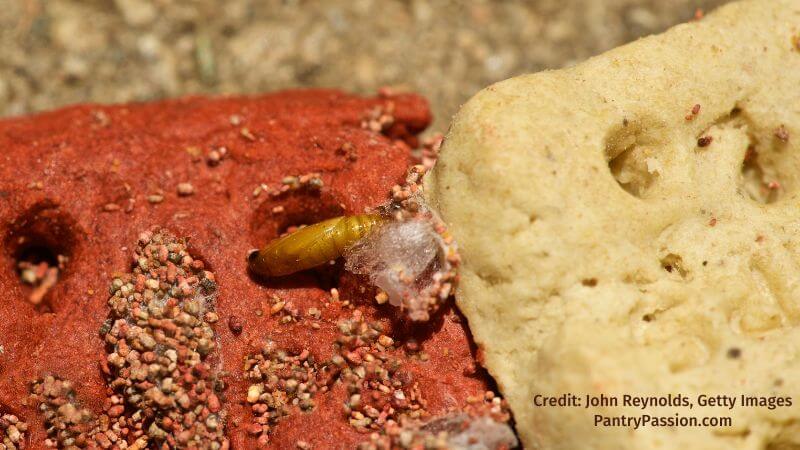
Paper deserves it’s own special mention. Pantry moth larvae can eat through paper and thin cardboard. Armed with this new information, it makes sense that food products should not be stored with paper products. The idea (and effort) of decanting food and storing it in air-tight glass jars begins to make sense.
Paper-eating bugs (and larvae) will eat paper because it is actually a starchy food source. Paper bags, cookbooks, magazines, tea bags, and anything else with paper in it can attract larvae and bugs. They are attracted to grains first, but that still means that paper stored in the food storage area is at risk for damage.
If you have an infestation, you will need to dispose of ALL the paper in your pantry to ensure no eggs or larvae are accidentally left behind.
Wonder what pantry moth eggs look like? They’re pretty small, microscopic, in fact. Check out Pantry Moths – a Kitchen’s Worst Nightmare to understand and view example of Indian moth infestations.

This includes:
- paper bags
- paper plates and cups
- cookbooks, magazines, and loose papers
- paper labels on metal food cans
It is possible to try to save books or papers by placing them in the freezer for 8 days. This will kill the larvae and eggs. Be aware that putting paper in the freezer can sometimes damage it. Before throwing out important papers or books, take photos of any information you want to keep.
Mystery sources of food for pantry moth larvae
In a Washington Post article, a reader mentioned that they felt that they couldn’t seem to beat a pantry moth infestation they seemed to have for years. They believed that the moths were coming from the basement, but they claimed that there was no food there. They were very frustrated that they couldn’t get rid of pantry moths.
The author of the article said that the only reason the infestation had lasted that long, was because there was still some type of food presence. The author offered that it could even be corn gluten meal used to fertilize plants and deter weeds. This just proves that homeowners need to review with fresh eyes, what they think “food” is.
Pantry moths can chew threw paper, thin carboard, and plastic. They prefer grain-based food, but will eat through starchy paper and other paper products.
Indian meal moth prevention
To prevent pantry moths in the first place, TAKE THEIR FOOD AWAY.
- Inspect all foods right in the grocery store, even before bringing it into your home. If there are any signs of moths, bag and discard the package, or return it and warn the store where you purchased it. Look for telltale signs of moths: small holes in the packaging and webbing in the tighter areas (bag folds) of the package.
- Store all foods in tightly sealed containers (glass, metal, or plastic containers) to prevent moths from spreading. Check all food that it is sealed well. Zip-lock type bags will still attract bugs, especially food particles in the seal opening.
- Keep areas that may collect crumbs, like toasters, clean; wipe down pantry shelves and wash off dusty off particles frequently. Pick up spills immediately.
- Place food items in a freezer for a week to kill any eggs or larvae that may be present.
- Keep your pantry COLD. A cold environment slows up the life cycle of the pantry moth. This gives you more time to discover and eradicate them before the get out of control.
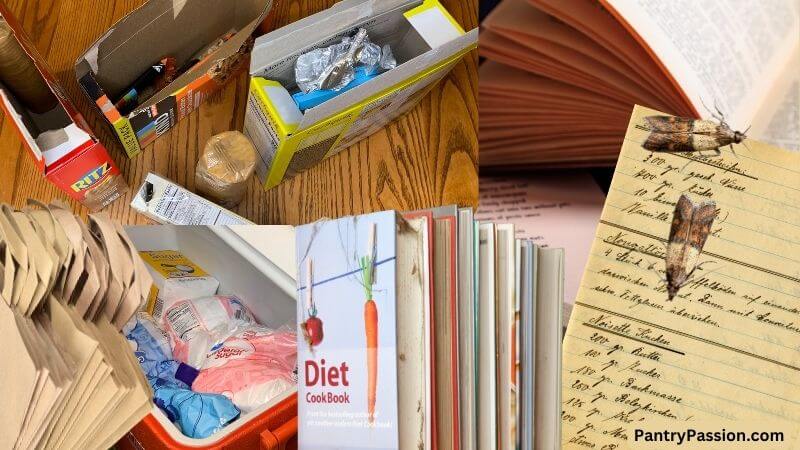
- Don’t store cookbooks, magazines, loose papers, and paper plates or cups in the same area as the pantry food – it creates a perfect environment for moths to lay eggs (cookbooks are filled with cracks and crevices).
- Use natural repellants to discourage moths from laying eggs in food storage areas.
I’ve written an extensive article and recommendations of air-tight flour proof containers, they can double as pantry moth proof containers.
How to get rid of an Indian moth infestation
Indian moth is the most common type of pantry moth. I may specifically reference Indian meal moths over general pantry moth infestations – prevention and extermination techniques apply to all types of moths attracted to pantry food.
NOTE: The University of Florida Entomology & Nematology Dept. direct that if you notice an infestation inside of a jar, and “If the jar had been tightly closed, the infestation would have died, either from lack of air or from a buildup of moisture that would have allowed the development of fungus to destroy the larvae and adults.”
ACT FAST. The pantry moth lifecycle is short and moths breed rapidly. I will say it again. It is imperative to act quickly in removal. Cleaning thoroughly is part of the Indian meal moth extermination process. It will remove and kill Indian meal moths, larvae, and eggs. After cleaning, I will discuss best pantry moth killers.
Here’s a how to get rid of pantry moths in your kitchen:
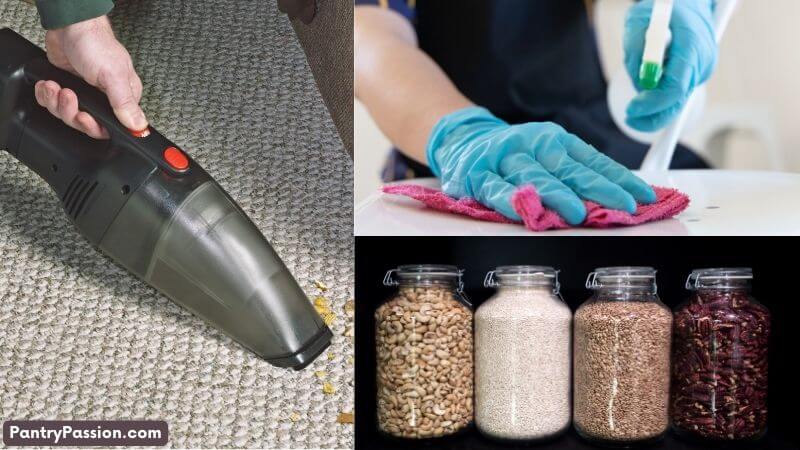
- REMOVE your food from the affected drawers, cupboards, or shelves – this means shelf liners, too – and vacuum really thoroughly paying attention to edges, cracks and crevices inside and out (this means taking out the bags inside of boxes and looking for clumps or webbing). Toss out anything that is infested. When you see larvae, most goods in your pantry are already at risk. Consider storing the removed food items in a plastic tote to monitor for any eggs or larvae you may have missed.
- Wipe down cans with hot water and soap with white vinegar mixed in. You may have to remove labels from cans because you might miss eggs that have been laid behind the label.
- If you have a door to your pantry, wipe the knobs and hinges with soap and hot water.
- Vacuum and mop the space meticulously. Throw away your vacuum bag. If your vacuum is bagless, wash out the dust compartment. Larvae can continue to live inside of your vacuum cleaner, re-emerging to cause more infestations.
- Wash the surfaces with hot water and soap. Moths detest vinegar in all forms, so add some of that to the bucket. Make sure to remove any remaining spilled food, eggs, or cocoons. CLEAN all surfaces thoroughly that may be affected and leave to dry. EVERY crack can hide larvae, this means paying close attention to nail holes, lifting up shelves, even the knobs and hinges of the pantry door. A toothpick can be a helpful tool – yes, it’s that important!
- KILL any eggs and larvae with a natural persistent spray. Apply to the affected storage unit
- MONITOR / PREVENT moths by placing pantry moth traps close to affected areas to monitor for adult moths and to break the breeding cycle
- REFRESH meal moth traps every 2 months. With warmer houses Pantry Moth damage and moth infestations are now a year-round problem
Indian meal moth killer, what you need to know
You know what to do to clean your pantry and the need to remove infected food to prevent pantry moths from laying eggs. That is probably the best Indian meal moth extermination method there is.
If you already have pantry moths, simply repelling pantry moths will not be enough – TAKE ALL THE STEPS ABOVE TO COMPLETELY CLEAN AN INFESTATION FIRST before setting out traps or natural repellants.
Indian meal moth traps/Flour and pantry moth traps
Pantry traps are going to be your most effective strategy against stopping the cycle of pantry moth and Indian meal moth infestations. Pantry moth pesticides are not a good idea because you don’t want to contaminate your food supply with harmful chemicals.
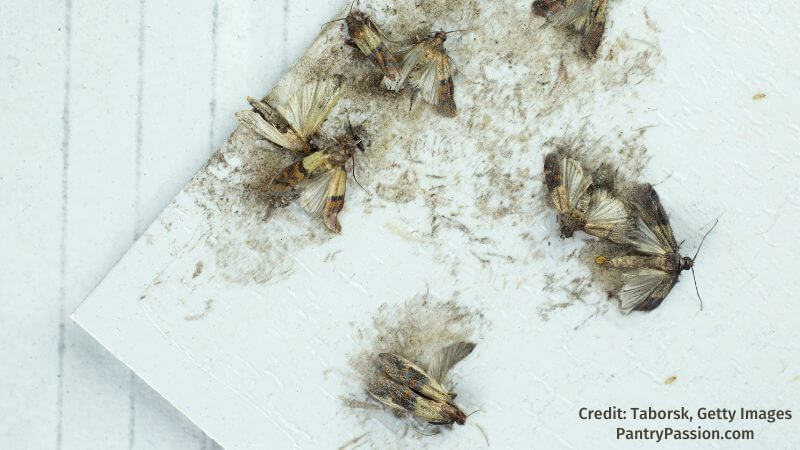
Put out pantry moth traps to capture the adult male moths. Pantry traps contain pheromone. A pheromone is a chemical that an animal produces which changes the behavior of another animal of the same species.
The traps lure male moths to them, and they get trapped to the glue boards and die. By killing the males, they are successfully prevented from fertilizing females, stopping the life cycle of the pantry moth.
As mentioned before, the pheromones on a pantry moth trap DO NOT attract clothes moths and will be ineffective on them.
TIPS WHEN USING PANTRY MOTH TRAPS:
- put the traps in the freezer briefly before opening them, to make it easier to remove the adhesive backing
- wash hands thoroughly before and after handling the trap, especially if you are a smoker – do not to touch the pheromone tabs with hands or the moths will be attracted to your skin
- place one trap in an area at a time.
- replace traps every 3 months or sooner if they fill with moths or become dusty
Note that the placement of a cloth moth trap will be different.
Best pantry moth trap
It’s not fair for me to claim a “best pantry moth trap.” I suspect that all of the pantry moth traps work effectively. If they don’t work, there is a chance there is something faulty with the pantry moth sticky trap, or you are not using the right trap for the right type of moth.
TIP: Male pantry moths may immediately come out into the open when a pantry moth trap is set out. The adhesive is so strong that that it is possible to chase down moths and catch they on a pantry moth trap sticky pad.
Things to look for when buying pantry moth traps:
- “dual” traps have pheromones to attract both pantry and clothes moths
- traps may have a hook or cardboard cutout for hanging up vertically
- get the most out of triangle-shaped traps by rotating the triangle to a freshly-exposed side
- some pantry traps are designed decoratively to blend into the surround
- some may be targeted to “flour moth” or “birdseed moth” but they are all the same
- some products may say they are “eco-friendly” but it is pertaining to the fact that they are made of cardboard – most of the pantry traps probably are eco-friendly
The traps don’t work on the female pantry moths, if you’re wondering why some moths still seem to be flying around. Feel free to chase them down and swat them with the sticky pantry moth trap, or just use a fly swatter, or electric fly swatter.
Here is a list of well-known indoor flour and pantry moth traps brands:
- Able Catch Pantry Moth Trap
- Aeroxon Pantry Moth Trap</